Places of the Bible
Michmash
City
Where the name appears
Events told in passages that name Michmash, and how many of their verses do. That is not the same as saying they happened here: a place can be named as a landmark, as somewhere being travelled to, or as the subject of a prophecy.
A dot is a moment; a bar is something that lasted, drawn to its length. The fainter the mark, the fewer verses name the place.
- Reign of Saul · 1094 BC · 7 verses
- Prophecies of Isaiah · 758 BC · 1 verse
What the spade found
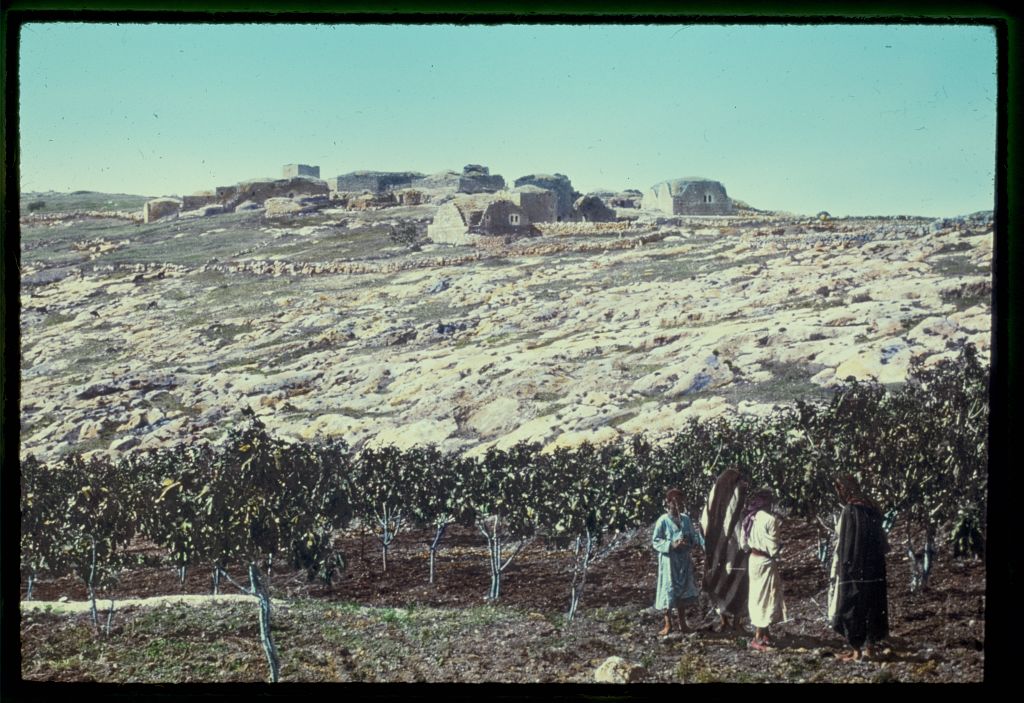
Michmash is generally identified with Khirbet el-Hara el-Fauqa and Mukhmas, a tell — a mound raised by one settlement built on the ruins of the last. It has been surveyed but not excavated, and at its largest covered 4 hectares.
Occupation shows in 6 dated phases: Middle Bronze Age II-III, Iron Age I, Iron Age II, Hellenistic, Roman, Byzantine.
The excavation is from the survey dataset From Villages to Empires (Zanoni and others, 2025), used under CC BY 4.0. The identification is the one modern scholarship settles on, compiled by OpenBible.info from over seventy works, also under CC BY 4.0. Identifying a mound with a biblical name is a scholarly judgement, and for some places it is still debated.
Easton’s Bible Dictionary
Something hidden, a town of Benjamin (Ezra 2:27), east of Bethel and south of Migron, on the road to Jerusalem (Isa. 10:28). It lay on the line of march of an invading army from the north, on the north side of the steep and precipitous Wady es-Suweinit (“valley of the little thorn-tree” or “the acacia”), and now bears the name of Mukhmas. This wady is called “the passage of Michmash” (1 Sam. 13:23). Immediately facing Mukhmas, on the opposite side of the ravine, is the modern representative of Geba, and behind this again are Ramah and Gibeah.
This was the scene of a great battle fought between the army of Saul and the Philistines, who were utterly routed and pursued for some 16 miles towards Philistia as far as the valley of Aijalon. “The freedom of Benjamin secured at Michmash led through long years of conflict to the freedom of all its kindred tribes.” The power of Benjamin and its king now steadily increased. A new spirit and a new hope were now at work in Israel.
From M. G. Easton, Illustrated Bible Dictionary (1893), in the public domain.
Named in 9 verses
The place, its people and its events come from Theographic, a knowledge graph of the Bible by Robert Rouse, used and shared under CC BY-SA 4.0.