Months, festivals & measures
Scripture keeps time by the moon and the harvest, and measures its world by the human body — the reach of a forearm, the spread of a hand, the load a donkey can carry. This page gathers that furniture into one place: the months of the Hebrew year, the feasts appointed in them, and the measures of length, quantity, weight, and money in both Testaments, each with the nearest honest modern equivalent. Every reference opens in the reader.
Scripture on this page is quoted from the King James Version (KJV), whichever translation you read in — the English names explained here, the bushel, the mite and the farthing among them, are its words.
The shape of the year
A biblical month begins when the new moon is seen — the Hebrew for month, chodesh, is close kin to chadash, new. A moon runs its course in about twenty-nine and a half days, so months alternate between twenty-nine days and thirty.
Twelve such months make roughly 354 days, eleven short of the sun’s year, and left alone the calendar would wander backward through the seasons. It was kept in place by adding a thirteenth month — a second Adar — roughly every third year. Scripture never legislates this, but it presumes it: Passover must fall with the barley ripe, for its month is Abib, “green ears” Deuteronomy 16:1, and the sheaf of firstfruits requires a harvest standing ready to cut Leviticus 23:10.
The year has two beginnings, and both are biblical. At the Exodus, the month of deliverance was made “the beginning of months” Exodus 12:2 — the religious year, from which Scripture numbers its months. The older agricultural year turned in the fall: the feast of ingathering stands “in the end of the year” Exodus 23:16, “at the year’s end” Exodus 34:22.
Most of the time the narrative simply numbers a month — “in the seventh month.” Before the exile four older Canaanite names appear; after it, the Babylonian names the Jews brought home from captivity, seven of which stand in the later books. The rest are known from Jewish usage outside Scripture, and the table marks them so.
The twelve months
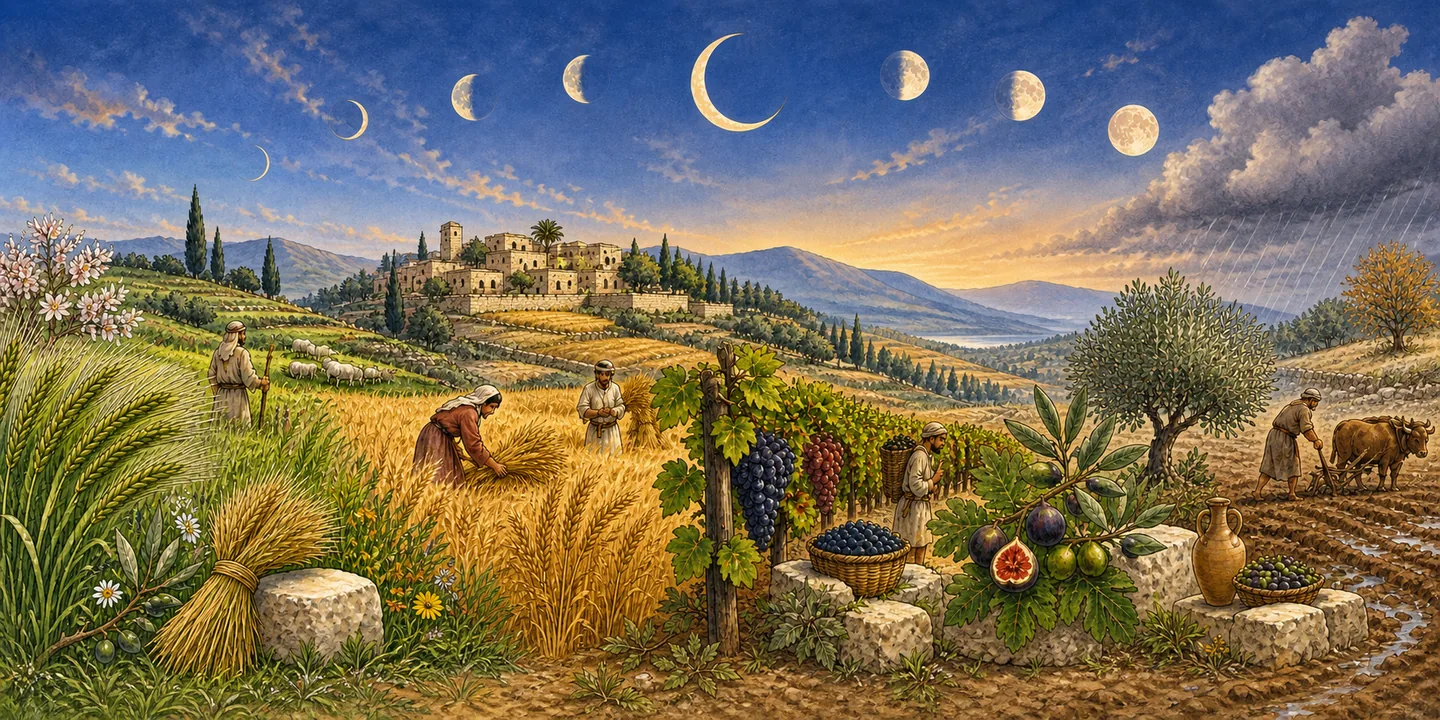 Barley · NisanWheat · SivanGrapes · ElulFirst rains · Bul
The numbering runs from the spring new year of Exodus 12:2. The modern equivalents are approximate by nature — a lunar month drifts against our solar calendar, so Nisan may open in March one year and April the next.
| # | Month | Hebrew | Falls in | In Scripture |
|---|---|---|---|---|
| 1 | Nisan, earlier Abib | ניסן | Mar–Apr | Neh 2:1; Est 3:7; as Abib Ex 13:4 |
| 2 | Iyyar, in Scripture Ziv | אייר | Apr–May | as Ziv 1 Kgs 6:1 |
| 3 | Sivan | סיון | May–Jun | Est 8:9 |
| 4 | Tammuz | תמוז | Jun–Jul | not named — “the fourth month,” Jer 39:2 |
| 5 | Av | אב | Jul–Aug | not named — “the fifth month,” 2 Kgs 25:8 |
| 6 | Elul | אלול | Aug–Sep | Neh 6:15 |
| 7 | Tishri, in Scripture Ethanim | תשרי | Sep–Oct | as Ethanim 1 Kgs 8:2 |
| 8 | Marcheshvan, in Scripture Bul | מרחשוון | Oct–Nov | as Bul 1 Kgs 6:38 |
| 9 | Kislev | כסלו | Nov–Dec | Neh 1:1; Zech 7:1 |
| 10 | Tevet | טבת | Dec–Jan | Est 2:16 |
| 11 | Shevat | שבט | Jan–Feb | Zech 1:7 |
| 12 | Adar | אדר | Feb–Mar | Est 3:7; Ezra 6:15 |
The four older names carry the farm year in them: Abib is the month of “green ears” of barley, Ziv of blossom, Ethanim of the “steady streams” that still flow when the summer wadis have failed, and Bul most likely of the returning rain. The year they trace is the one the feasts are pinned to: barley ripens in Nisan, wheat in Sivan, and grapes, figs, and olives come in toward Tishri, when the early rains begin — Scripture’s “first rain and the latter rain” Deuteronomy 11:14, autumn sowing rain and spring ripening rain.
Tammuz, kept from later Jewish usage, is a strange survival: it is the name of the Babylonian god whose mourners Ezekiel saw weeping at the temple gate Ezekiel 8:14, and the month kept the name of the god’s midsummer mourning. In a leap year the added month is a second Adar, and the feasts of Adar move into it.
The appointed feasts
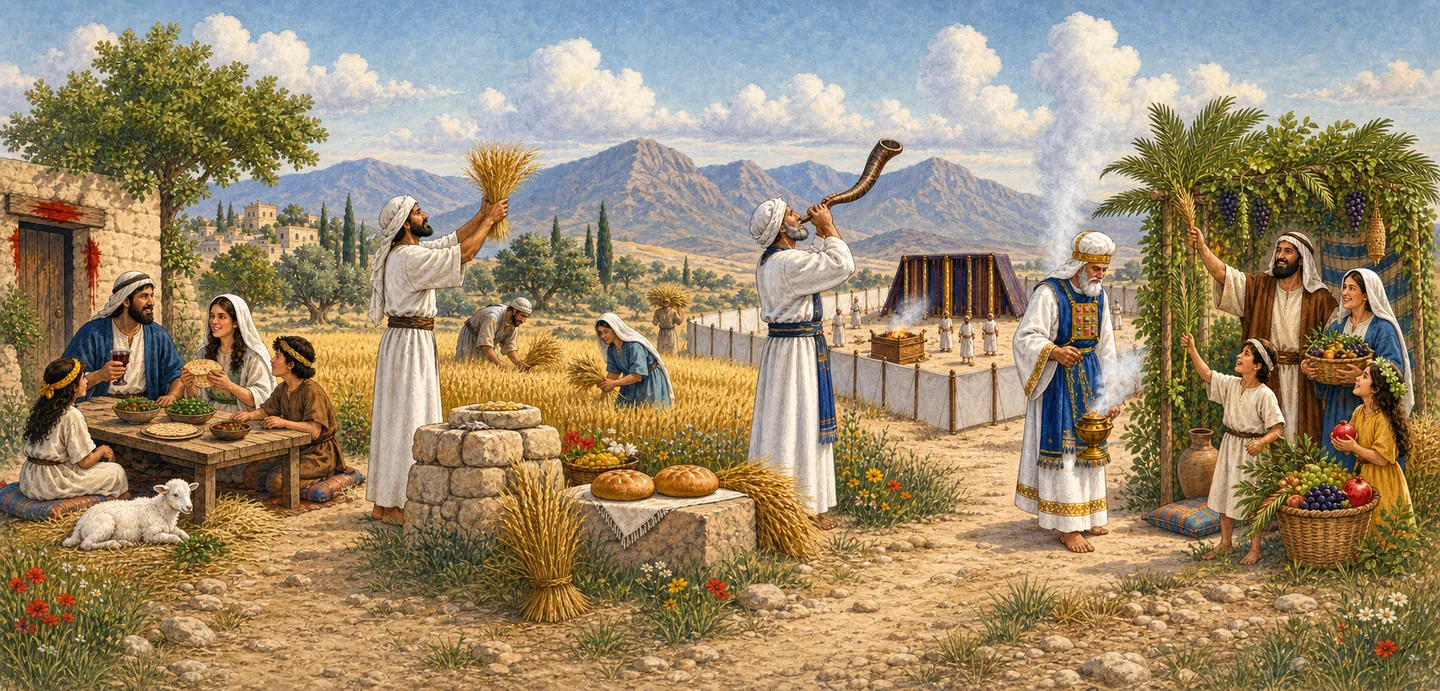 PassoverFirstfruitsWeeksTrumpetsAtonementBooths
The appointed feasts are listed by the LORD himself in Leviticus 23 — “these are my feasts” Leviticus 23:2. They fall in two clusters, one at each harvest: the spring feasts around the barley, the fall feasts around the ingathering. The days given here are days of the Hebrew months above, not of ours. One of the seven is not a feast at all but a fast.
| Feast | When | What it marks | In Scripture |
|---|---|---|---|
| Passover — Pesach | Nisan 14, at twilight | The Exodus — the lamb whose blood turned death aside | Ex 12:1-14; Lev 23:5; John 19:14; 1 Cor 5:7 |
| Unleavened Bread — Matzot | Nisan 15–21 | The haste of leaving Egypt; leaven put out of the houses for seven days | Ex 12:15-20; Lev 23:6-8; Deut 16:3 |
| Firstfruits | during the feast, “the morrow after the sabbath” | The first sheaf of the barley waved before the LORD | Lev 23:9-14; 1 Cor 15:20 |
| Weeks — Shavuot, in Greek Pentecost | fifty days on, in Sivan | The wheat harvest; two leavened loaves offered | Ex 34:22; Lev 23:15-21; Deut 16:9-12; Acts 2:1 |
| Trumpets | Tishri 1 | A memorial of trumpet blast, opening the solemn seventh month | Lev 23:23-25; Num 29:1 |
| Day of Atonement — Yom Kippur | Tishri 10 | A fast: the high priest enters the holiest place once in the year, and the scapegoat carries sin away | Lev 16; Lev 23:26-32; Heb 9:7-12 |
| Booths — Sukkot, or Tabernacles | Tishri 15–21, and an eighth day of assembly | The wilderness years remembered in shelters, with the year’s produce gathered in | Lev 23:33-43; Deut 16:13-15; Zech 14:16; John 7:2 |
Three of these were pilgrimage feasts: at Unleavened Bread, Weeks, and Booths every man was to appear before the LORD at the sanctuary Exodus 23:14-17, Deuteronomy 16:16. That standing rhythm is why the Gospels find Jerusalem crowded at Passover, and why Jews “out of every nation under heaven” are in the city on the day of Pentecost Acts 2:5. It is at Booths that Jesus stands and cries “in the last day, that great day of the feast” John 7:37.
Later feasts, and the sacred cycles
Two feasts arose after the Law was given. Purim, on Adar 14 and 15, keeps the deliverance of the Jews in Esther’s day and takes its name from pur, the lot Haman cast Esther 9:26 — the one feast established within Scripture itself outside the Law of Moses. Dedication — Hanukkah — begins on Kislev 25 and runs eight days, remembering the cleansing of the temple after its defilement under Antiochus in 164 BC, between the Testaments. Scripture mentions it once, in passing: Jesus walks the temple in Solomon’s porch at the feast of the dedication, “and it was winter” John 10:22.
Around the yearly feasts run the standing cycles: the weekly Sabbath, the seventh day Genesis 2:3, Exodus 20:8-11; the new moon opening each month with offerings and the trumpet Numbers 28:11, Psalm 81:3; the sabbatical year, in which the land itself rested every seventh year Exodus 23:10-11, Leviticus 25:4; and the jubilee, the fiftieth year, proclaiming “liberty throughout all the land unto all the inhabitants thereof” Leviticus 25:10.
Length and distance
The short measures are the body’s own: the finger, the hand, the span of a stretched hand, and above them all the cubit — elbow to fingertip — in which the ark, the tabernacle, and both temples are dimensioned. There are two cubits to watch for: the common cubit, and a longer one of “a cubit and an hand breadth” used in Ezekiel’s visionary temple Ezekiel 43:13 and apparently in Solomon’s, whose plan is given “by cubits after the first measure” 2 Chronicles 3:3. The cubit crosses into the New Testament unchanged John 21:8; the road measures there — furlong and mile — are Greek and Roman.
| Measure | Relation | ≈ Modern | In Scripture |
|---|---|---|---|
| Fingerbreadth | a quarter handbreadth | 0.75 in · 1.9 cm | Jer 52:21 |
| Handbreadth | four fingers | 2.9 in · 7.4 cm | Ex 25:25; Ps 39:5 |
| Span | half a cubit | 8.75 in · 22 cm | Ex 28:16; 1 Sam 17:4 |
| Cubit | elbow to fingertip | 17.5 in · 44.5 cm | Gen 6:15; Ex 25:10 |
| Long cubit | a cubit and a handbreadth | 20.4 in · 52 cm | Ezek 40:5; 2 Chr 3:3 |
| Reed | six long cubits | 10.2 ft · 3.1 m | Ezek 40:5; Rev 21:15 |
| Fathom | the arms outstretched | 6 ft · 1.8 m | Acts 27:28 |
| Furlong — stadion | 600 Greek feet | 607 ft · 185 m | Luke 24:13; John 6:19; Rev 14:20 |
| Mile — Roman | a thousand double paces | 4,860 ft · 1.48 km | Matt 5:41 |
| Sabbath day’s journey | about 2,000 cubits | 0.6 mi · 0.9 km | Acts 1:12 |
| A day’s journey | no fixed length | near 20 mi · 30 km | Gen 30:36; Jonah 3:4; Luke 2:44 |
To make two of these concrete: Goliath’s “six cubits and a span” 1 Samuel 17:4 is about nine feet nine inches, and the walk to Emmaus, “threescore furlongs” Luke 24:13, is about seven miles.
Dry and liquid measures
The whole system hangs on two vessels of the same size: the ephah for grain and the bath for liquids, each a tenth of a homer — Ezekiel states the relation outright Ezekiel 45:11. The homer above them is a donkey’s load; its Hebrew shares a root with the word for donkey. Below the ephah, Scripture itself fixes the omer: “an omer is the tenth part of an ephah” Exodus 16:36.
Dry measure
| Measure | Relation | ≈ Modern | In Scripture |
|---|---|---|---|
| Cab | an eighteenth of an ephah | 1 dry qt · 1.2 L | 2 Kgs 6:25 |
| Omer | a tenth of an ephah | 2 dry qt · 2.2 L | Ex 16:16; Ex 16:36 |
| Seah — usually “measure” | a third of an ephah | 6.5 dry qt · 7.3 L | Gen 18:6; 2 Kgs 7:1 |
| Ephah | the standard dry measure | 0.6 bushel · 22 L | Ruth 2:17; Lev 19:36; Zech 5:6 |
| Lethech | half a homer | 3 bushels · 110 L | Hos 3:2 |
| Homer, or cor | ten ephahs — a donkey’s load | 6 bushels · 220 L | Lev 27:16; Isa 5:10; Ezek 45:11 |
Liquid measure
| Measure | Relation | ≈ Modern | In Scripture |
|---|---|---|---|
| Log | a twelfth of a hin | 0.6 pt · 0.3 L | Lev 14:10 |
| Hin | a sixth of a bath | 1 gal · 3.7 L | Ex 29:40; Ezek 4:11 |
| Bath | the liquid twin of the ephah | 5.8 gal · 22 L | 1 Kgs 7:26; Isa 5:10 |
| Cor | ten baths | 58 gal · 220 L | 1 Kgs 5:11; Ezek 45:14 |
In the New Testament
The Greek text uses its own vessels, mostly hidden behind an English “measure” or “bushel.” Two of them are the old Hebrew measures wearing Greek dress.
| Measure | Rendered as | ≈ Modern | In Scripture |
|---|---|---|---|
| Choinix | “a measure” of wheat | 1 dry qt · 1.1 L | Rev 6:6 |
| Xestes | the “pots” of the washings | 1 pt · 0.5 L | Mark 7:4 |
| Modius | the “bushel” the lamp is not put under | 1 peck · 9 L | Matt 5:15 |
| Saton | “measures” of meal | the seah above | Matt 13:33 |
| Batos | “measures” of oil | the bath above | Luke 16:6 |
| Koros | “measures” of wheat | the cor above | Luke 16:7 |
| Metretes | the “firkins” of the water jars | 10 gal · 39 L | John 2:6 |
The choinix was a day’s bread ration, which is what gives the third seal its edge: “a measure of wheat for a penny” Revelation 6:6 is a whole day’s wage buying a single day’s food. And the six stone jars at Cana, at two or three metretes apiece John 2:6, held somewhere between 120 and 180 gallons.
Weights
Weighing was done with a balance and a bag of stones, and the standard was the shekel — the word itself just means “weight,” from the verb to weigh. The Law fixes its subdivision — “a shekel is twenty gerahs” Exodus 30:13 — and names a sanctuary standard so that sacred dues could not be paid with a light stone.
| Weight | Relation | ≈ Modern | In Scripture |
|---|---|---|---|
| Gerah | a twentieth of a shekel | 0.02 oz · 0.6 g | Ex 30:13; Ezek 45:12 |
| Bekah | half a shekel | 0.2 oz · 5.7 g | Ex 38:26 |
| Pim | about two-thirds of a shekel | 0.27 oz · 7.6 g | 1 Sam 13:21 |
| Shekel | the standard | 0.4 oz · 11.4 g | Ex 30:13; Gen 23:16 |
| Mina — maneh | fifty shekels; sixty in Ezekiel’s reckoning | 1.25 lb · 570 g | 1 Kgs 10:17; Ezek 45:12 |
| Talent — kikkar | three thousand shekels | 75 lb · 34 kg | Ex 38:25-26; 1 Kgs 10:14 |
| Litra — the NT “pound” | the Roman libra | 11.5 oz · 327 g | John 12:3; John 19:39 |
The pim has a story worth telling. The word occurs once, in the Philistines’ price list for sharpening Israel’s tools 1 Samuel 13:21, and for centuries nobody knew what it meant — the King James translators, with nothing to go on, rendered it “a file.” Then small stone weights turned up in the digs with pim inscribed on them, about two-thirds of a shekel each, and the sentence came back into focus: it is the sharpening fee. One Hebrew word, recovered by a scale-weight.
Money
For most of the Old Testament, money is not coin but weighed metal — every weight in the table above is also a price. Abraham buys the cave of Machpelah for four hundred shekels of silver “current money with the merchant” Genesis 23:16, and a thousand years later Jeremiah still weighs the seventeen shekels for his field Jeremiah 32:9-10.
Coined money enters Scripture after the exile with the Persian daric, a gold coin Ezra 8:27 — and the Chronicler, writing for readers who knew coins, reckons even David’s gifts in darics for them 1 Chronicles 29:7. By the Gospels the pocket held a mixture: Roman coin for the empire, Greek coin for trade, and Tyrian shekels for the temple.
No column of dollar values is offered here, deliberately: silver’s price says nothing about what a coin meant to the person holding it. The honest yardstick is labor — a denarius was a laborer’s full day Matthew 20:2 — and the table reckons from there.
| Coin | Worth | In labour | In Scripture |
|---|---|---|---|
| Lepton — the widow’s “mite” | half a quadrans; the smallest coin in circulation | about 6 minutes’ work* | Mark 12:42; Luke 21:2 |
| Quadrans — “farthing” | a sixty-fourth of a denarius | about 11 minutes’ work* | Matt 5:26; Mark 12:42 |
| Assarion — also “farthing” | a sixteenth of a denarius; the price of two sparrows | about 45 minutes’ work* | Matt 10:29; Luke 12:6 |
| Denarius — “penny” | a laborer’s day | one day’s work | Matt 20:2; Mark 6:37; Rev 6:6 |
| Drachma — “piece of silver” | the Greek cousin of the denarius, near equal | one day’s work | Luke 15:8 |
| Didrachma — the temple-tax “tribute” | two drachmas, owed yearly by every man | two days’ work | Matt 17:24 |
| Stater — “a piece of money” | four drachmas — the temple tax for two | four days’ work | Matt 17:27 |
| Shekel of silver | four denarii or so, in Tyrian coin | four days’ work | Zech 11:12; Matt 26:15 |
| Mina — “pound” | a hundred drachmas | about four months’ work* | Luke 19:13 |
| Talent | a sum, not a coin: six thousand denarii | about twenty years’ work | Matt 18:24; Matt 25:15 |
* Reckoned on a twelve-hour working day John 11:9 and a working year of about three hundred days. The rows without a star need neither.
Two of the sums carry their meaning in the arithmetic. The thirty pieces of silver Zechariah 11:12, Matthew 26:15 are the Law’s compensation for a slave gored by an ox Exodus 21:32 — a slave’s price. And in the parable, the servant forgiven ten thousand talents — sixty million denarii — seizes a fellow servant over a hundred Matthew 18:24-28: the two debts stand six hundred thousand to one.
Hours and watches
The day runs from evening to evening — “the evening and the morning were the first day” Genesis 1:5, “from even unto even” Leviticus 23:32 — so a feast begins at sundown the night before its calendar date.
Daylight was divided into twelve hours — “are there not twelve hours in the day?” John 11:9 — counted from sunrise. The third hour is midmorning, about nine Mark 15:25; the sixth is noon Matthew 20:5; the ninth, about three in the afternoon, is the hour of prayer Acts 3:1. Because an hour was a twelfth of the daylight there was, summer hours ran long and winter hours short.
The night was kept in watches. The Old Testament counts three: the beginning of the watches Lamentations 2:19, the middle watch Judges 7:19, and the morning watch Exodus 14:24. By the Gospels the Roman division of four is in use, and Jesus names them all in a sentence: “at even, or at midnight, or at the cockcrowing, or in the morning” Mark 13:35. It is in the fourth watch, the last dark hours before dawn, that he comes walking on the sea Matthew 14:25.
How sure these numbers are
Ancient measures had no bureau of standards behind them. They grew from the body and the farm, and they varied — between Egypt and Babylon, between one town’s market and the next, between the common cubit and the long one. So every modern equivalent on this page is accurate only to within a few percent, and printed reference works differ among themselves by about that much.
What is solid is what Scripture itself states: that an omer is a tenth of an ephah Exodus 16:36, that ephah and bath are one size and the homer holds ten Ezekiel 45:11, that a shekel is twenty gerahs Exodus 30:13. The ratios are Scripture’s; only the absolute sizes rest on archaeology — inscribed shekel-stones averaging a little over eleven grams, jar fragments marked bath, the pim weights that unlocked their own verse. Where the spade and the text meet, they agree well.
And the Bible is not indifferent to the subject of this page. “Just balances, just weights, a just ephah, and a just hin, shall ye have” Leviticus 19:36; the bag with two sets of stones is forbidden outright Deuteronomy 25:13-15; “a false balance is abomination to the LORD: but a just weight is his delight” Proverbs 11:1. A page of measures is, by Scripture’s own lights, a page about honesty.