At first sight Psalm 51 is a poem of sorrow for guilt. Behind its words is the language of the sanctuary, whose services show how God atones for sin and reconciles us to himself.
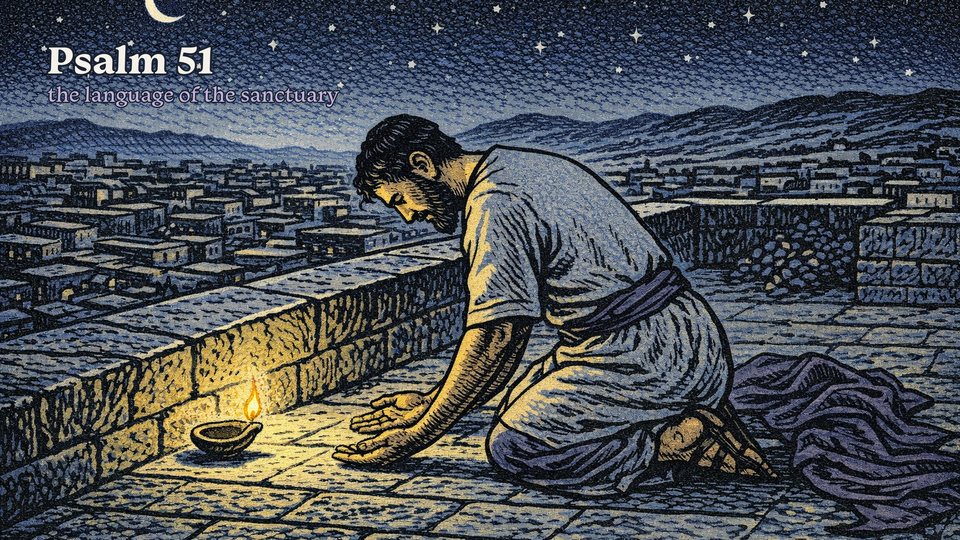
Quotations from the King James Version, with its verse numbers. Counts are the Hebrew text’s own, word by word, from STEPBible’s TAHOT (CC BY). The words are on wash, purge, hyssop, create and clean. Pictures in the Verné slovo woodblock style, generated by AI image and video models from our own scene descriptions; synthetic narration; music composed with ElevenLabs.
Nathan and David
The psalm's heading sets it after Nathan came to David, and the story is in 2 Samuel: Nathan says, Thou art the man, and David answers that he has sinned against the LORD (2 Samuel 12:7, 2 Samuel 12:13). The prayer that follows uses the words of the law of purity.
Wash and clean: the words of the purity laws
Wash me thoroughly from my iniquity. Cleanse me from my sin.
The King James's wash is kabas H3526. It stands fifty-one times in the Old Testament, thirty-nine of them in the laws of the sanctuary: Exodus 25-40, Leviticus and Numbers. Clean was the priest's word, for the priest pronounced a person clean (Leviticus 13:6).
Hyssop and purge: the sanctuary's cleansing
Purify me with hyssop, and I will be clean. Wash me, and I will be whiter than snow.
Hyssop H231 belonged to the sanctuary's cleansing of the leper (Leviticus 14:4) and of all who had touched the dead (Numbers 19:18). The King James's purge in this verse is chata H2398, to take away sin. It stands fifteen times in this sense, and thirteen are the sanctuary's rites. Only in this verse does a man ask God to do it to him.
Wash, cleanse and purge stand together in three verses of the Old Testament: the Levites set apart (Numbers 8:21), the cleansing from death (Numbers 19:19) and this psalm.
The Day of Atonement
David names his wrong three ways, transgression, iniquity and sin. The three stand together in seven verses, and one of them is the Day of Atonement, when the high priest confessed over the live goat:
Aaron shall lay both his hands on the head of the live goat, and confess over him all the iniquities of the children of Israel, and all their transgressions, even all their sins; and he shall put them on the head of the goat, and shall send him away into the wilderness by the hand of a man who is ready.
So David asks God for what was performed on that day:
Hide your face from my sins, and blot out all of my iniquities.
A clean heart: bara and tahor
Create in me a clean heart, O God. Renew a right spirit within me.
In Hebrew the line begins lev tahor bera li, Elohim. Bara H1254, to create, is God's own verb: it stands forty-eight times in this sense, and the one who creates is always God, from the Bible's first verse (Genesis 1:1). David does not ask to be mended. He asks to be made new. And tahor H2889, clean, is what God declares on the Day of Atonement (Leviticus 16:30).
Why David turns to God directly
Don’t throw me from your presence, and don’t take your Holy Spirit from me.
The unclean could not stay near God's dwelling (Leviticus 13:46), and David asks to stay.
For you don’t delight in sacrifice, or else I would give it. You have no pleasure in burnt offering.
For adultery and murder the law named death (Leviticus 20:10, Numbers 35:31). The offerings covered sins of ignorance (Leviticus 4:2), but the sanctuary's service had no offering for a sin done presumptuously (Numbers 15:30), so David turns to God directly.
The sacrifices of God are a broken spirit. O God, you will not despise a broken and contrite heart.
David knew what the sanctuary meant: it is God who cleanses, God who forgives, and God who brings the sinner back to himself.
The New Testament carries the prayer on
how much more will the blood of Christ, who through the eternal Spirit offered himself without defect to God, cleanse your conscience from dead works to serve the living God?
If we confess our sins, he is faithful and righteous to forgive us the sins and to cleanse us from all unrighteousness.
The quotations on this page are shown in your own translation, so their words may differ from the King James the film reads and counts.