Places of the Bible
Beersheba
City
Where the name appears
Events told in passages that name Beersheba, and how many of their verses do. That is not the same as saying they happened here: a place can be named as a landmark, as somewhere being travelled to, or as the subject of a prophecy.
A dot is a moment; a bar is something that lasted, drawn to its length. The fainter the mark, the fewer verses name the place.
- Reign of David · 1054 BC · 5 verses
- Reign of Solomon · 1014 BC · 1 verse
- Prophecies of Elijah · 909 BC · 1 verse
- Reign of Joash · 878 BC · 1 verse
- Prophecies of Amos · 787 BC · 1 verse
- Reign of Josiah · 640 BC · 1 verse
What the spade found
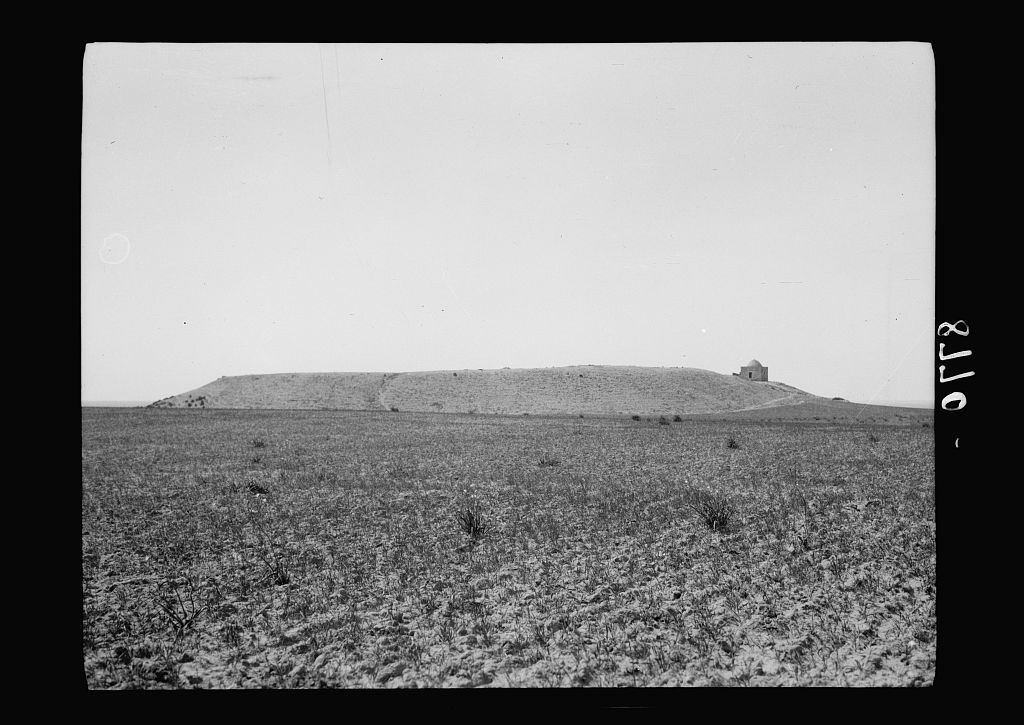
Beersheba is generally identified with Tell Beersheba, a tell — a mound raised by one settlement built on the ruins of the last. It has been surveyed but not excavated, and at its largest covered 1.5 hectares.
Occupation shows in 7 dated phases: Iron Age I, Iron Age IIa, Iron Age IIb, Iron Age III (Persian), Hellenistic, Early Roman, Late Roman.
The excavation is from the survey dataset From Villages to Empires (Zanoni and others, 2025), used under CC BY 4.0. The identification is the one modern scholarship settles on, compiled by OpenBible.info from over seventy works, also under CC BY 4.0. Identifying a mound with a biblical name is a scholarly judgement, and for some places it is still debated.
Easton’s Bible Dictionary
Well of the oath, or well of seven, a well dug by Abraham, and so named because he and Abimelech here entered into a compact (Gen. 21:31). On re-opening it, Isaac gave it the same name (Gen. 26:31-33). It was a favourite place of abode of both of these patriarchs (21:33-22:1, 19; 26:33; 28:10). It is mentioned among the “cities” given to the tribe of Simeon (Josh. 19:2; 1 Chr. 4:28). From Dan to Beersheba, a distance of about 144 miles (Judg. 20:1; 1 Chr. 21:2; 2 Sam. 24:2), became the usual way of designating the whole Promised Land, and passed into a proverb. After the return from the Captivity the phrase is narrowed into “from Beersheba unto the valley of Hinnom” (Neh. 11:30). The kingdom of the ten tribes extended from Beersheba to Mount Ephraim (2 Chr. 19:4). The name is not found in the New Testament. It is still called by the Arabs Bir es-Seba, i.e., “well of the seven”, where there are to the present day two principal wells and five smaller ones. It is nearly midway between the southern end of the Dead Sea and the Mediterranean.
From M. G. Easton, Illustrated Bible Dictionary (1893), in the public domain.
Named in 32 verses
- Genesis
- 21:14, 21:31, 21:32, 21:33, 22:19, 26:23, 26:33, 28:10, 46:1, 46:5
- Joshua
- 15:28, 19:2
- Judges
- 20:1
- 1 Samuel
- 3:20, 8:2
- 2 Samuel
- 3:10, 17:11, 24:2, 24:7, 24:15
- 1 Kings
- 4:25, 19:3
- 2 Kings
- 12:1, 23:8
- 1 Chronicles
- 4:28, 21:2
- 2 Chronicles
- 19:4, 24:1, 30:5
- Nehemiah
- 11:27, 11:30
- Amos
- 5:5
The place, its people and its events come from Theographic, a knowledge graph of the Bible by Robert Rouse, used and shared under CC BY-SA 4.0.