Places of the Bible
Bethlehem
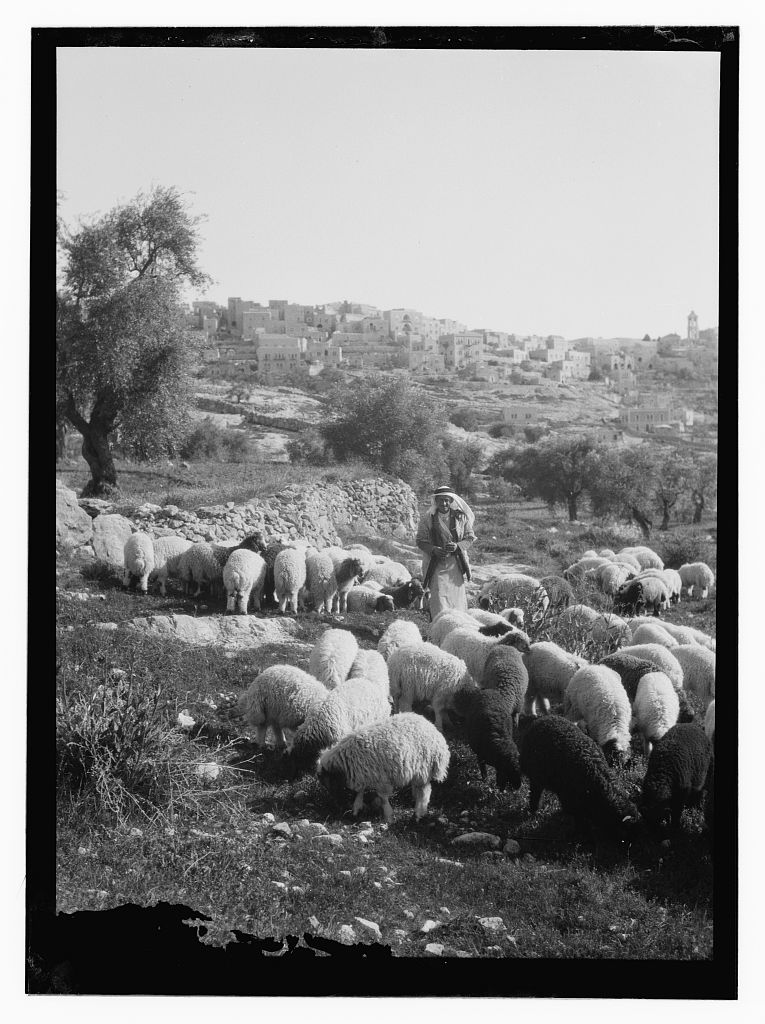
A city in the “hill country” of Judah · City
- Born here
- Chilion, Elimelech, Jesus Christ, Mahlon
What happened here
- Wise Men Visit Jesus · 3 BC
- Herod slays male children · 3 BC
- Birth of Jesus · 3 BC
Where the name appears
Events told in passages that name Bethlehem, and how many of their verses do. That is not the same as saying they happened here: a place can be named as a landmark, as somewhere being travelled to, or as the subject of a prophecy.
A dot is a moment; a bar is something that lasted, drawn to its length. The fainter the mark, the fewer verses name the place.
- Rachel dies giving birth to Benjamin · 1738 BC · 1 verse
- Judgeship of Ibzan · 1145 BC · 2 verses
- Reign of Saul · 1094 BC · 4 verses
- David Kills Goliath · 1066 BC · 1 verse
- Reign of David · 1054 BC · 5 verses
- Prophecies of Jeremiah · 627 BC · 1 verse
- Wise Men Visit Herod · 3 BC · 4 verses
What the spade found
Bethlehem is generally identified with Bethlehem. It has been surveyed but not excavated.
Occupation shows in 9 dated phases: Chalcolithic, Early Bronze Age, Iron Age I, Iron Age II, Iron Age III (Persian), Hellenistic, Byzantine, Early Roman, Late Roman.
The excavation is from the survey dataset From Villages to Empires (Zanoni and others, 2025), used under CC BY 4.0. The identification is the one modern scholarship settles on, compiled by OpenBible.info from over seventy works, also under CC BY 4.0. Identifying a mound with a biblical name is a scholarly judgement, and for some places it is still debated.
Easton’s Bible Dictionary
A city in the “hill country” of Judah. It was originally called Ephrath (Gen. 35:16, 19; 48:7; Ruth 4:11). It was also called Beth-lehem Ephratah (Micah 5:2), Beth-lehem-judah (1 Sam. 17:12), and “the city of David” (Luke 2:4). It is first noticed in Scripture as the place where Rachel died and was buried “by the wayside,” directly to the north of the city (Gen. 48:7). The valley to the east was the scene of the story of Ruth the Moabitess. There are the fields in which she gleaned, and the path by which she and Naomi returned to the town. Here was David’s birth-place, and here also, in after years, he was anointed as king by Samuel (1 Sam. 16:4-13); and it was from the well of Bethlehem that three of his heroes brought water for him at the risk of their lives when he was in the cave of Adullam (2 Sam. 23:13-17). But it was distinguished above every other city as the birth-place of “Him whose goings forth have been of old” (Matt. 2:6; comp. Micah 5:2). Afterwards Herod, “when he saw that he was mocked of the wise men,” sent and slew “all the children that were in Bethlehem, and in all the coasts thereof, from two years old and under” (Matt. 2:16, 18; Jer. 31:15).
Bethlehem bears the modern name of Beit-Lahm, i.e., “house of flesh.” It is about 5 miles south of Jerusalem, standing at an elevation of about 2,550 feet above the sea, thus 100 feet higher than Jerusalem.
There is a church still existing, built by Constantine the Great (A.D. 330), called the “Church of the Nativity,” over a grotto or cave called the “holy crypt,” and said to be the “stable” in which Jesus was born. This is perhaps the oldest existing Christian church in the world. Close to it is another grotto, where Jerome the Latin father is said to have spent thirty years of his life in translating the Scriptures into Latin.
From M. G. Easton, Illustrated Bible Dictionary (1893), in the public domain.
Named in 32 verses
- Genesis
- 35:19, 48:7
- Judges
- 12:8, 12:10
- Ruth
- 1:19, 1:22, 2:4, 4:11
- 1 Samuel
- 16:4, 17:15, 20:6, 20:28
- 2 Samuel
- 2:32, 23:14, 23:15, 23:16, 23:24
- 1 Chronicles
- 11:16, 11:17, 11:18, 11:26
- 2 Chronicles
- 11:6
- Ezra
- 2:21
- Nehemiah
- 7:26
- Jeremiah
- 41:17
- Matthew
- 2:1, 2:5, 2:6, 2:8, 2:16
- Luke
- 2:4, 2:15
The place, its people and its events come from Theographic, a knowledge graph of the Bible by Robert Rouse, used and shared under CC BY-SA 4.0.