Places of the Bible
Gilgal
first named in Deuteronomy 11:30 · City
Where the name appears
Events told in passages that name Gilgal, and how many of their verses do. That is not the same as saying they happened here: a place can be named as a landmark, as somewhere being travelled to, or as the subject of a prophecy.
A dot is a moment; a bar is something that lasted, drawn to its length. The fainter the mark, the fewer verses name the place.
- War with Canaanites · 1450 BC · 10 verses
- Dividing the land · 1444 BC · 1 verse
- Deliverance by Ehud · 1360 BC · 1 verse
- Reign of Saul · 1094 BC · 11 verses
- Reign of David · 1054 BC · 2 verses
- Prophecies of Amos · 787 BC · 2 verses
- Prophecies of Hosea · 784 BC · 3 verses
- Prophecies of Micah · 753 BC · 1 verse
Easton’s Bible Dictionary
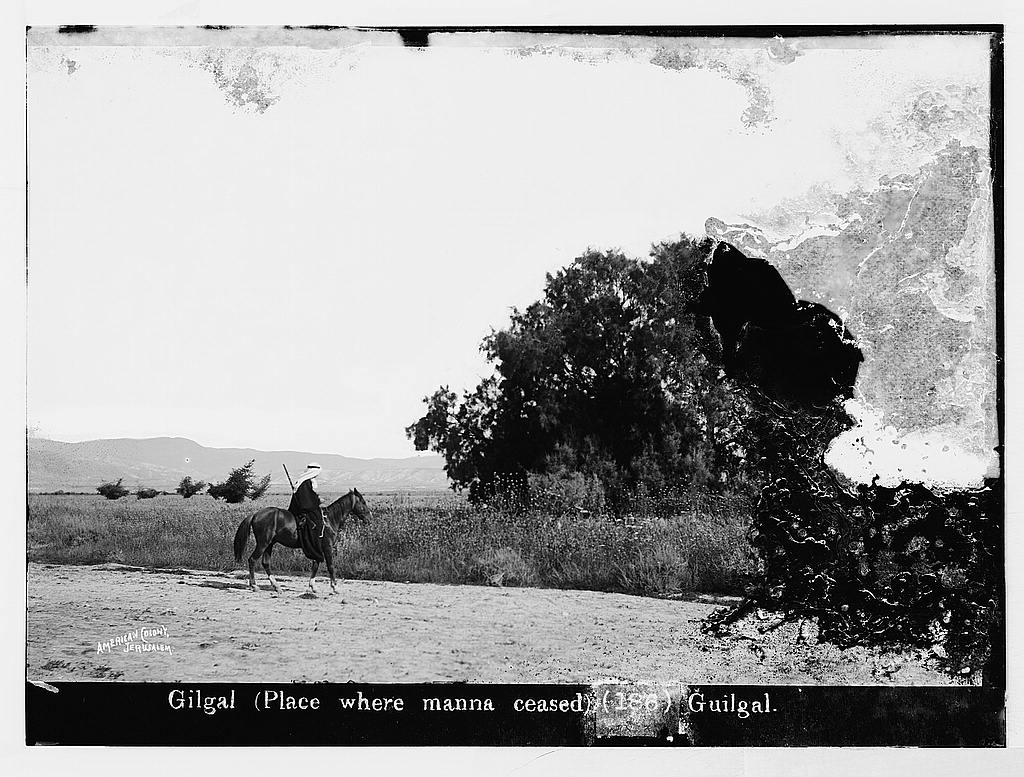
From the solemn transaction of the reading of the law in the valley of Shechem between Ebal and Gerizim the Israelites moved forward to Gilgal, and there made a permanent camp (Josh. 9:6; 10:6). It was “beside the oaks of Moreh,” near which Abraham erected his first altar (Gen. 12:6, 7). This was one of the three towns to which Samuel resorted for the administration of justice (1 Sam. 7:16), and here also he offered sacrifices when the ark was no longer in the tabernacle at Shiloh (1 Sam. 10:8; 13:7-9). To this place, as to a central sanctuary, all Israel gathered to renew their allegiance to Saul (11:14). At a later period it became the scene of idolatrous worship (Hos. 4:15; 9:15). It has been identified with the ruins of Jiljilieh, about 5 miles south-west of Shiloh and about the same distance from Bethel.
From M. G. Easton, Illustrated Bible Dictionary (1893), in the public domain.
Named in 35 verses
- Deuteronomy
- 11:30
- Joshua
- 4:19, 4:20, 5:9, 5:10, 9:6, 10:6, 10:7, 10:9, 10:15, 10:43, 14:6, 15:7
- Judges
- 2:1, 3:19
- 1 Samuel
- 7:16, 10:8, 11:14, 11:15, 13:4, 13:7, 13:8, 13:12, 13:15, 15:12, 15:21, 15:33
- 2 Samuel
- 19:15, 19:40
- Hosea
- 4:15, 9:15, 12:11
- Amos
- 4:4, 5:5
- Micah
- 6:5
The place, its people and its events come from Theographic, a knowledge graph of the Bible by Robert Rouse, used and shared under CC BY-SA 4.0.