Places of the Bible
Lachish
City
Where the name appears
Events told in passages that name Lachish, and how many of their verses do. That is not the same as saying they happened here: a place can be named as a landmark, as somewhere being travelled to, or as the subject of a prophecy.
A dot is a moment; a bar is something that lasted, drawn to its length. The fainter the mark, the fewer verses name the place.
- War with Canaanites · 1450 BC · 9 verses
- Reign of Amaziah · 838 BC · 1 verse
- Prophecies of Isaiah · 758 BC · 2 verses
- Prophecies of Micah · 753 BC · 1 verse
- Reign of Hezekiah · 725 BC · 3 verses
- Prophecies of Jeremiah · 627 BC · 1 verse
What the spade found
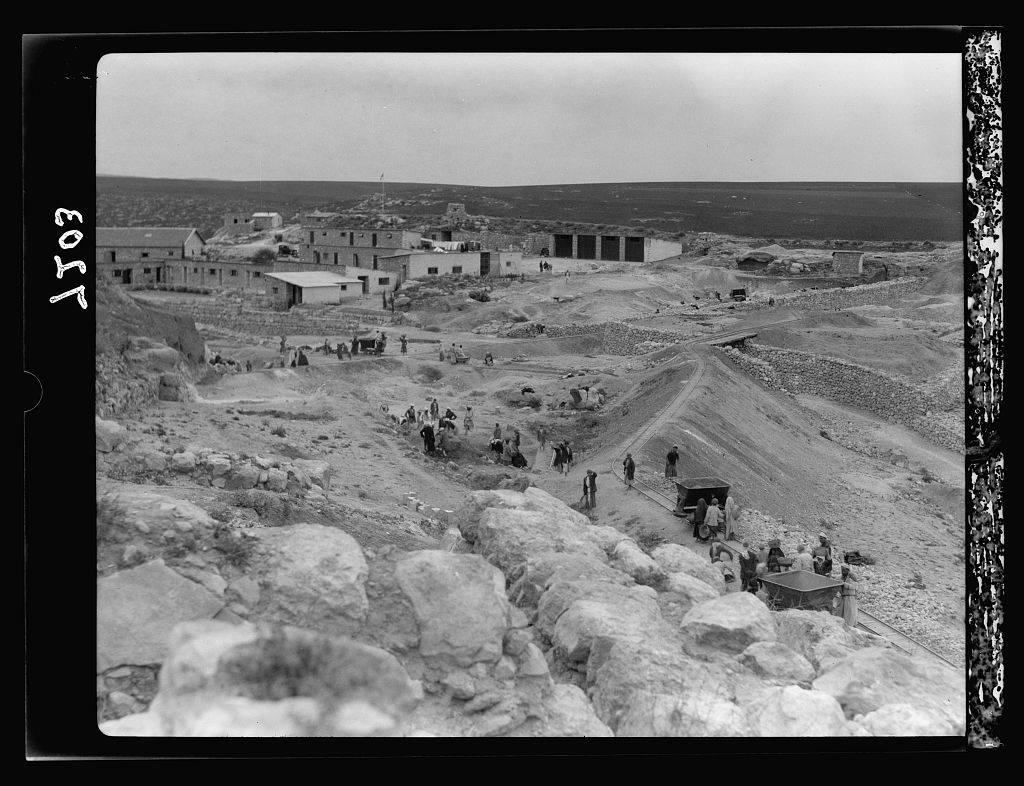
Lachish is generally identified with Tel Lakhish, a tell — a mound raised by one settlement built on the ruins of the last. It has been excavated, and at its largest covered 12 hectares.
Occupation shows in 16 dated phases: Chalcolithic, Early Bronze Age I, Early Bronze Age II, Early Bronze Age III, Middle Bronze Age I, Middle Bronze Age II-III, Late Bronze Age I, Late Bronze Age II, Late Bronze Age III, Iron Age IIa, Iron Age IIb, Iron Age IIc, Babylonian, Iron Age III (Persian), Hellenistic, Byzantine.
The excavation is from the survey dataset From Villages to Empires (Zanoni and others, 2025), used under CC BY 4.0. The identification is the one modern scholarship settles on, compiled by OpenBible.info from over seventy works, also under CC BY 4.0. Identifying a mound with a biblical name is a scholarly judgement, and for some places it is still debated.
Easton’s Bible Dictionary
Impregnable, a royal Canaanitish city in the Shephelah, or maritime plain of Palestine (Josh. 10:3, 5; 12:11). It was taken and destroyed by the Israelites (Josh. 10:31-33). It afterwards became, under Rehoboam, one of the strongest fortresses of Judah (2 Chr. 10:9). It was assaulted and probably taken by Sennacherib (2 Kings 18:14, 17; 19:8; Isa. 36:2). An account of this siege is given on some slabs found in the chambers of the palace of Koyunjik, and now in the British Museum. The inscription has been deciphered as follows:, “Sennacherib, the mighty king, king of the country of Assyria, sitting on the throne of judgment before the city of Lachish: I gave permission for its slaughter.”
Lachish has been identified with Tell-el-Hesy, where a cuneiform tablet has been found, containing a letter supposed to be from Amenophis at Amarna in reply to one of the Amarna tablets sent by Zimrida from Lachish. This letter is from the chief of Atim (=Etam, 1 Chr. 4:32) to the chief of Lachish, in which the writer expresses great alarm at the approach of marauders from the Hebron hills. “They have entered the land,” he says, “to lay waste...strong is he who has come down. He lays waste.” This letter shows that “the communication by tablets in cuneiform script was not only usual in writing to Egypt, but in the internal correspondence of the country. The letter, though not so important in some ways as the Moabite stone and the Siloam text, is one of the most valuable discoveries ever made in Palestine” (Conder’s Tell Amarna Tablets, p. 134).
Excavations at Lachish are still going on, and among other discoveries is that of an iron blast-furnace, with slag and ashes, which is supposed to have existed B.C. 1500. If the theories of experts are correct, the use of the hot-air blast instead of cold air (an improvement in iron manufacture patented by Neilson in 1828) was known fifteen hundred years before Christ.
From M. G. Easton, Illustrated Bible Dictionary (1893), in the public domain.
Named in 22 verses
- Joshua
- 10:3, 10:5, 10:23, 10:31, 10:32, 10:33, 10:34, 10:35, 12:11, 15:39
- 2 Kings
- 14:19, 18:14, 18:17, 19:8
- 2 Chronicles
- 11:9, 25:27, 32:9
- Nehemiah
- 11:30
- Isaiah
- 36:2, 37:8
- Jeremiah
- 34:7
- Micah
- 1:13
The place, its people and its events come from Theographic, a knowledge graph of the Bible by Robert Rouse, used and shared under CC BY-SA 4.0.