Places of the Bible
Shiloh
City
Where the name appears
Events told in passages that name Shiloh, and how many of their verses do. That is not the same as saying they happened here: a place can be named as a landmark, as somewhere being travelled to, or as the subject of a prophecy.
A dot is a moment; a bar is something that lasted, drawn to its length. The fainter the mark, the fewer verses name the place.
- Reign of Saul · 1094 BC · 1 verse
- Reign of Solomon · 1014 BC · 1 verse
- Reign of Jeroboam I · 974 BC · 2 verses
- Prophecies of Jeremiah · 627 BC · 5 verses
What the spade found
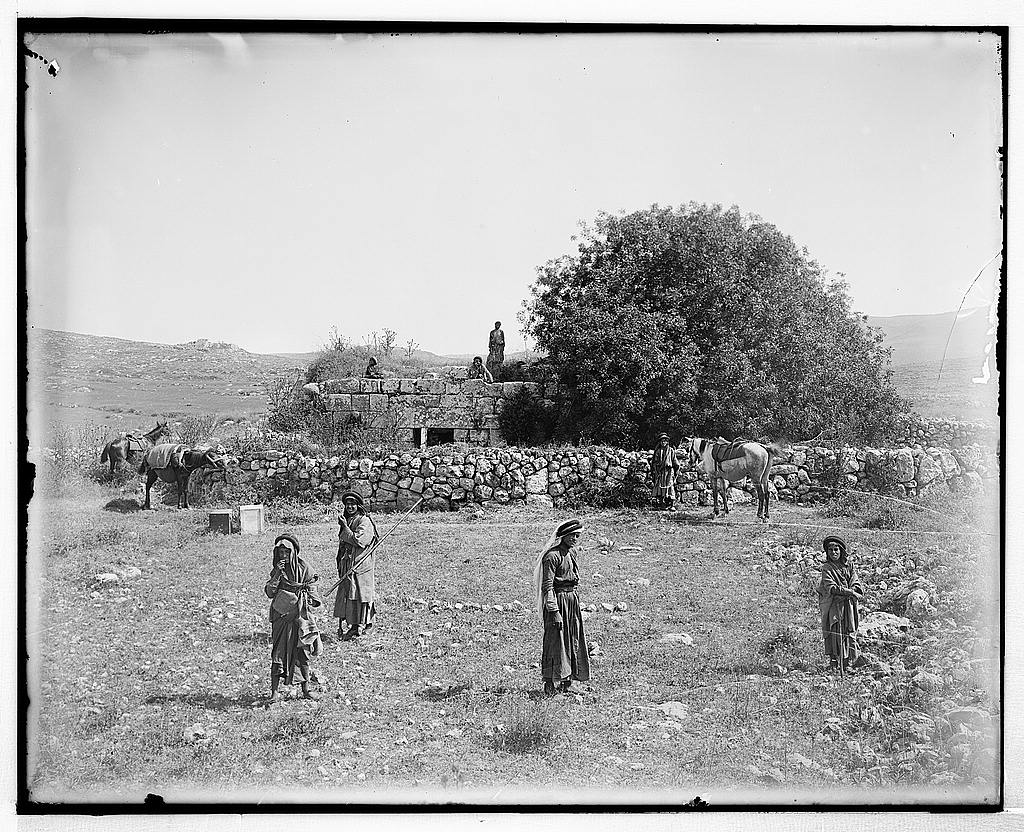
Shiloh is generally identified with Tell Shiloh, a tell — a mound raised by one settlement built on the ruins of the last. It has been surveyed but not excavated, and at its largest covered 0.75 hectares.
Occupation shows in 2 dated phases: Middle Bronze Age I, Middle Bronze Age II-III.
The excavation is from the survey dataset From Villages to Empires (Zanoni and others, 2025), used under CC BY 4.0. The identification is the one modern scholarship settles on, compiled by OpenBible.info from over seventy works, also under CC BY 4.0. Identifying a mound with a biblical name is a scholarly judgement, and for some places it is still debated.
Easton’s Bible Dictionary
Generally understood as denoting the Messiah, “the peaceful one,” as the word signifies (Gen. 49:10). The Vulgate Version translates the word, “he who is to be sent,” in allusion to the Messiah; the Revised Version, margin, “till he come to Shiloh;” and the LXX., “until that which is his shall come to Shiloh.” It is most simple and natural to render the expression, as in the Authorized Version, “till Shiloh come,” interpreting it as a proper name (comp. Isa. 9:6).
Shiloh, a place of rest, a city of Ephraim, “on the north side of Bethel,” from which it is distant 10 miles (Judg. 21:19); the modern Seilun (the Arabic for Shiloh), a “mass of shapeless ruins.” Here the tabernacle was set up after the Conquest (Josh. 18:1-10), where it remained during all the period of the judges till the ark fell into the hands of the Philistines. “No spot in Central Palestine could be more secluded than this early sanctuary, nothing more featureless than the landscape around; so featureless, indeed, the landscape and so secluded the spot that from the time of St. Jerome till its re-discovery by Dr. Robinson in 1838 the very site was forgotten and unknown.” It is referred to by Jeremiah (7:12, 14; 26:4-9) five hundred years after its destruction.
From M. G. Easton, Illustrated Bible Dictionary (1893), in the public domain.
Named in 30 verses
- Joshua
- 18:1, 18:8, 18:9, 18:10, 19:51, 21:2, 22:9, 22:12
- Judges
- 18:31, 21:12, 21:19, 21:21
- 1 Samuel
- 1:3, 1:9, 1:24, 2:14, 3:21, 4:3, 4:4, 4:12, 14:3
- 1 Kings
- 2:27, 14:2, 14:4
- Psalms
- 78:60
- Jeremiah
- 7:12, 7:14, 26:6, 26:9, 41:5
The place, its people and its events come from Theographic, a knowledge graph of the Bible by Robert Rouse, used and shared under CC BY-SA 4.0.