Genesis tells the making of the world in 56 verses. Exodus gives 457 verses to one tent. Walk through the tabernacle room by room, from the gate to the ark, and meet the high priest who opened the way in.

Quotations from the King James Version, with the World English Bible beneath them on screen. The counts are the King James text’s own: Genesis 1 and 2 have 56 verses; Exodus 25 to 31 and 35 to 40 have 457. Tabernacle is mishkan, the dwelling. Hebrew and Greek words from STEPBible’s TAHOT and TAGNT (CC BY); the Septuagint’s from Swete, digitized by First1KGreek (CC BY-SA). Pictures in the Verné slovo woodblock style, generated by AI image and video models from our own scene descriptions; synthetic narration; music composed with ElevenLabs.
A tent eight times the size of the world
Genesis tells the making of the world in 56 verses, its first two chapters. Exodus gives 457 verses to one tent: seven chapters say how the tent is to be made (Exodus 25 to 31, 243 verses), and six more say how it was made (Exodus 35 to 40, 214 verses). The Bible gives the tabernacle eight times the room it gives the world. Why would it do that?
Because God himself asked for the tent. The story starts on Mount Sinai:
Yahweh’s glory settled on Mount Sinai, and the cloud covered it six days. The seventh day he called to Moses out of the middle of the cloud.
Six days of waiting, and on the seventh day God speaks. The first thing he asks for is not a law or a battle plan. It is a tent:
Let them make me a sanctuary, that I may dwell among them.
The pattern
Listen to the word dwell. In Hebrew it is וְשָׁכַנְתִּי, from shakan H7931: to settle, to live among. In the very next verse the tent takes its name from that word. Tabernacle is הַמִּשְׁכָּן, mishkan H4908, the dwelling, the place where God lives (Exodus 25:9). The tabernacle is God's home among his people.
God even says why he brought Israel out of Egypt:
They shall know that I am Yahweh their God, who brought them out of the land of Egypt, that I might dwell among them: I am Yahweh their God.
We usually tell the exodus as a story of freedom, and it is one. But God tells it as a story of a home. He brought his people out so that he could live with them.
And God leaves nothing to guesswork. Moses is to build after the pattern of the tabernacle, and God says it twice (Exodus 25:9):
See that you make them after their pattern, which has been shown to you on the mountain.
Pattern is בְּתַבְנִיתָם, from tavnit H8403. Every board and every ring is God's own design, because the tent was God's own idea. That is the first half of the answer to all those verses: God asked for a home among his people, and the God who planned every ring of that tent was planning to live near people like us.
The court
You may have seen the tabernacle as a diagram, a box inside a box. Stand at ground level instead. A long wall of white linen runs around the court, and in that whole wall there is one way in, a gate on the east side, hung in blue, purple and scarlet (Exodus 27:13–16). One gate. Jesus once said:
I am the door. If anyone enters in by me, he will be saved, and will go in and go out and will find pasture.
He was speaking of a sheepfold, not of the tent, so this is a link of sense rather than a quotation. But the picture is the same: there is one way in, and the way in is open.
Step through the gate, and the first thing you meet is an altar. Before anyone goes further, there is a sacrifice, and the sacrifice is God's gift:
For the life of the flesh is in the blood. I have given it to you on the altar to make atonement for your souls; for it is the blood that makes atonement by reason of the life.
God gave the blood, and God lit the fire: when the first offerings were laid on the altar, fire came out from before the LORD and consumed them (Leviticus 9:24). Every morning and every evening a lamb was offered there (Exodus 29:38–39). In the Greek Old Testament that lamb is ἀμνοὺς, amnos G286, and amnos is the word John the Baptist used when he saw Jesus coming:
The next day, he saw Jesus coming to him, and said, “Behold, the Lamb of God, who takes away the sin of the world!
No New Testament writer calls this altar the cross. The altar and the cross are a link of sense. The lamb is the same word.
Between the altar and the tent stood a basin of bronze, the laver, where the priests washed their hands and their feet before they went in, that they die not (Exodus 30:18–21). Even the bronze was a gift: the laver was made of the lookingglasses of the women (Exodus 38:8). The women gave their mirrors.
Now think of what the court is saying. No one walked through that gate with something to offer that God had not given first. The blood was his gift. The fire was his. The water was his command. And that is still how anyone comes to God: we receive what he gives. The way in begins with what God gives.
The holy place
Go through the door of the tent itself. Only the priests came in here, and no daylight came with them. In the lamplight three things stand. On the right, the north side, is a table covered with gold, and on the left, the south side, a lampstand (Exodus 26:35).
On the table lies bread:
You shall set bread of the presence on the table before me always.
Shewbread, in Hebrew, is לֶחֶם פָּנִים, lechem panim, the bread of the face: bread set out before the face of God. Twelve loaves, laid out fresh every Sabbath (Leviticus 24:5–8).
The lampstand was hammered out of one piece of gold (Exodus 25:31; Exodus 25:36), with seven lamps (Exodus 25:37), and its light was never to go out: the oil was given to cause the lamp to burn always (Exodus 27:20). Ahead, in front of the veil, stood a small altar for incense, burned every morning and every evening, a perpetual incense before the LORD (Exodus 30:7–8).
Now watch one word. Alway, always and perpetual are one word in Hebrew, תָּמִיד, tamid H8548: continually, without a break. The bread before God's face, tamid. The lamp, tamid. The incense, tamid. And the high priest carried the names of the tribes over his heart:
Aaron shall bear the names of the children of Israel in the breastplate of judgment on his heart, when he goes in to the holy place, for a memorial before Yahweh continually.
Tamid again. The word stands in eight verses of these chapters.
The incense has a meaning the Bible gives itself. A psalm prays:
Let my prayer be set before you like incense; the lifting up of my hands like the evening sacrifice.
And in Revelation John sees an angel at the golden altar before the throne:
The smoke of the incense, with the prayers of the saints, went up before God out of the angel’s hand.
Incense there is θυμιαμάτων, from thymiama G2368, the word the Greek Old Testament uses for the incense of this very altar (θυμίαμα, Exodus 30:8). So the holy place is a room where God keeps his people before him, day and night. When you pray, your prayer goes where that incense went: before God.
The veil and the ark
At the back of the holy place hangs a heavy curtain, the veil, woven in blue, purple and scarlet, with cherubim worked into it (Exodus 26:31). It divides the holy place from the most holy (Exodus 26:33).
The Bible has shown us cherubim before. The first cherubim in the Bible stand at the gate of Eden:
So he drove out the man; and he placed cherubim at the east of the garden of Eden, and a flaming sword which turned every way, to guard the way to the tree of life.
Cherub is keruv H3742, the same word in Eden, הַכְּרֻבִים, and on the veil, כְּרֻבִים. And watch the verb placed. Placed is וַיַּשְׁכֵּן, from shakan, the tabernacle's own word. The first time the Bible says shakan, God is not settling among people. He is setting cherubim to guard the way.
Since Eden the way to God has been guarded, and here it is guarded again. Even the high priest could not walk through that veil when he chose:
and Yahweh said to Moses, “Tell Aaron your brother not to come at just any time into the Most Holy Place within the veil, before the mercy seat which is on the ark; lest he die; for I will appear in the cloud on the mercy seat.
That he die not. The danger was never in the curtain. God is holy, and sin cannot stand before him. Our need is the same today. We want God near, and on our own our sin keeps us outside.
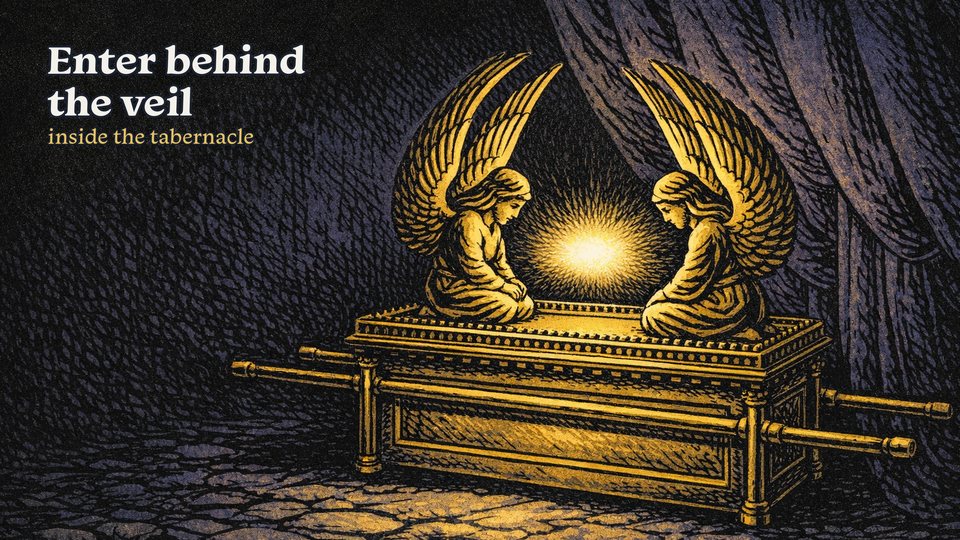
But look at what waits behind the veil. A chest of wood overlaid with gold, the ark (Exodus 25:10–11). In it lies the testimony (Exodus 25:16), the tables of stone written by the finger of God (Exodus 31:18). Over it is a lid of pure gold with two cherubim above it, the mercy seat, הַכַּפֹּרֶת, kapporet H3727. And God says what the mercy seat is for:
There I will meet with you, and I will tell you from above the mercy seat, from between the two cherubim which are on the ark of the covenant, all that I command you for the children of Israel.
God's law lies underneath, and God's meeting place is mercy.
In the Greek Old Testament the mercy seat is ἱλαστήριον, hilastērion G2435. The letter to the Hebrews uses that word for this very lid (Hebrews 9:5). And Paul uses it once, of Jesus:
whom God sent to be an atoning sacrifice through faith in his blood, for a demonstration of his righteousness through the passing over of prior sins, in God’s forbearance;
Propitiation is the same Greek word as mercy seat. How that verse is best put into English is debated, and this page does not settle it. But notice who sets the mercy seat forth. God does.
And one man was allowed through the veil to that mercy seat:
but into the second the high priest alone, once in the year, not without blood, which he offers for himself and for the errors of the people.
So the way in was not closed for ever. It was kept for a priest, who went in with a sacrifice and carried the names of the people on his heart.
High priest, ἀρχιερέα, archiereus G749, stands 123 times in the New Testament. In the Gospels and Acts the high priests are Caiaphas, Annas and their house. Only one book of the New Testament calls Jesus by that title, the letter to the Hebrews, and it does so again and again:
14 Having then a great high priest who has passed through the heavens, Jesus, the Son of God, let’s hold tightly to our confession. 15 For we don’t have a high priest who can’t be touched with the feeling of our infirmities, but one who has been in all points tempted like we are, yet without sin.
Jesus knows your weakness from the inside. Only the high priest could go in, and Jesus is our high priest.
Finished and filled
Before a single board is cut, something terrible happens. Moses is still on the mountain, and the people below grow tired of waiting. They melt their gold into a calf and say, These be thy gods, O Israel, which brought thee up out of the land of Egypt (Exodus 32:4). God had said he brought them out to live among them. Now they give the credit to a calf. And God answers that he will not go up in the midst of them, lest he consume them in the way (Exodus 33:3).
The tent could have ended there. Three chapters, 93 verses, stand between the plans and the building, and they are the darkest in the book. But Moses prays. He does not pretend the people are better than they are. He asks God to come anyway:
He said, “If now I have found favor in your sight, Lord, please let the Lord go among us, even though this is a stiff-necked people; pardon our iniquity and our sin, and take us for your inheritance.”
And God answers with his own name:
Yahweh passed by before him, and proclaimed, “Yahweh! Yahweh, a merciful and gracious God, slow to anger, and abundant in loving kindness and truth,
Then the tent is built after all. Sinners build the tent, for a God who has pardoned them. If you think you have failed God too badly for him to come near, remember the calf, and then remember what came after the calf.
When the work is done, Exodus tells it in the words of creation. Set the two side by side:
God saw everything that he had made, and, behold, it was very good. There was evening and there was morning, a sixth day.
Moses saw all the work, and behold, they had done it as Yahweh had commanded. They had done so; and Moses blessed them.
Saw, all and behold are the same Hebrew words, and blessed is the word of the seventh day (Genesis 2:3). Genesis says God ended his work (Genesis 2:2), and Exodus says so Moses finished the work (Exodus 40:33). Ended and finished are one word, וַיְכַל, kalah H3615, and work is הַמְּלָאכָה, melakhah H4399, the same in both. Those two words stand together in only seven verses of the Old Testament. Even God's speeches about the tent come seven times, and the seventh is about the Sabbath (Exodus 31:12–17).
That is the second half of the answer. The tent is told like a new creation. In Eden God lived with people, and people were driven out. In the tabernacle God makes a way to live with them again.
And then God moves in:
Then the cloud covered the Tent of Meeting, and Yahweh’s glory filled the tabernacle.
Remember the mountain. A cloud covered Sinai, and the glory abode upon it (Exodus 24:15–16). Covered, cloud, glory and abode: all four Hebrew words of Sinai come back at the tent, and abode is shakan once more. God has come down the mountain to live in a tent, among the tents of his people.
But one more sentence follows, and it is hard:
Moses wasn’t able to enter into the Tent of Meeting, because the cloud stayed on it, and Yahweh’s glory filled the tabernacle.
Not even Moses. God is at home among his people, and the way into his presence is still shut. The story goes on in the next book. Aaron is anointed as priest (Leviticus 8:12), the first sacrifices are made, and then:
Moses and Aaron went into the Tent of Meeting, and came out, and blessed the people; and Yahweh’s glory appeared to all the people.
In that same chapter the fire came out from before the LORD. The priest and the sacrifice opened the door that even Moses could not open. God moved in among sinners, and a priest went in with a sacrifice.
The true tabernacle
Centuries later a temple of stone stood where the tent once stood, with a veil before its holiest room. Then John opened his Gospel with this:
The Word became flesh and lived among us. We saw his glory, such glory as of the only born Son of the Father, full of grace and truth.
Dwelt is ἐσκήνωσεν, from skēnoō G4637, to pitch a tent. It is made from skēnē G4633, the word the Greek Old Testament uses for the tabernacle (σκηνὴν, Exodus 40:34). A tent, and the glory. Moses could not go in to the glory. In Jesus the glory came out to us, full of grace and truth.
But the veil still stood. Then, on a Friday afternoon outside Jerusalem, Jesus cried again with a loud voice and yielded up the ghost (Matthew 27:50):
Behold, the veil of the temple was torn in two from the top to the bottom. The earth quaked and the rocks were split.
Veil, in Matthew, is καταπέτασμα, katapetasma G2665, the word the Greek Old Testament uses for the veil before the ark (καταπέτασμα, Exodus 26:31). From the top to the bottom: the veil was opened from above. And the letter to the Hebrews says what the torn veil means:
19 Having therefore, brothers, boldness to enter into the holy place by the blood of Jesus, 20 by the way which he dedicated for us, a new and living way, through the veil, that is to say, his flesh,
The veil was his flesh. The way in was opened by his death.
The story does not end at a grave. On the third day Jesus rose, and when he went up, Hebrews says where he went:
For Christ hasn’t entered into holy places made with hands, which are representations of the true, but into heaven itself, now to appear in the presence of God for us;
For us. Here is the whole tabernacle in one sentence: God made the way in himself, and in Jesus he opened it for good.
Now remember the pattern Moses was shown on the mountain. Hebrews quotes God's words to Moses, and calls the tent on earth a shadow:
who serve a copy and shadow of the heavenly things, even as Moses was warned by God when he was about to make the tabernacle, for he said, “See, you shall make everything according to the pattern that was shown to you on the mountain.”
Pattern there is τύπον, from typos G5179, the very word the Greek Old Testament wrote in Exodus 25:40 (τύπον). The tent was the shadow. And Hebrews gives the sum of it all:
1 Now in the things which we are saying, the main point is this: we have such a high priest, who sat down on the right hand of the throne of the Majesty in the heavens, 2 a servant of the sanctuary and of the true tabernacle which the Lord pitched, not man.
The tabernacle has one more page. At the end of the Bible John hears a voice:
I heard a loud voice out of heaven saying, “Behold, God’s dwelling is with people; and he will dwell with them, and they will be his people, and God himself will be with them as their God.
Tabernacle is σκηνὴ and dwell is σκηνώσει, the tent words again. And John sees no temple in that city at all (Revelation 21:22): the Lord God Almighty and the Lamb are the temple of it. No veil. No court. No one left standing outside. And they shall see his face (Revelation 22:4).
The way in
Six steps, one tent. The pattern: God asked for a home among his people. The court: the way in begins with what God gives. The holy place: God keeps his people before him, always. The veil and the ark: only the high priest could go in, and Jesus is our high priest. Finished and filled: God moved in among sinners, and a priest went in with a sacrifice. The true tabernacle: in Jesus the way is open, and God will live with us for ever.
That is why one tent takes 457 verses. The tabernacle is God's way of living among sinners. He made the way in himself, and in Jesus he opened it for good.
So the way stands open, and Hebrews says what to do with an open way:
let’s draw near with a true heart in fullness of faith, having our hearts sprinkled from an evil conscience and having our body washed with pure water,
Sprinkled and washed: the same picture as the court, the blood and the water, given now by Jesus. You do not have to stand outside. Come near to God today, through Jesus, by the way he opened. And the Jesus who went in for us is coming back for us:
so Christ also, having been offered once to bear the sins of many, will appear a second time, not to deal with sin, but to save those who are eagerly waiting for him.