Ai
One of the royal cities of the Canaanites · City
31 verses · 4 books
What happened here
- 1920 BCAbraham enters Canaan
Where the name appears
Events told in passages that name Ai, and how many of their verses do. That is not the same as saying they happened here: a place can be named as a landmark, as somewhere being travelled to, or as the subject of a prophecy.
- 1919 BCAbraham and Lot Separate
1 verse
Genesis13:3 - 1450 BCWar with Canaanites
What the spade found
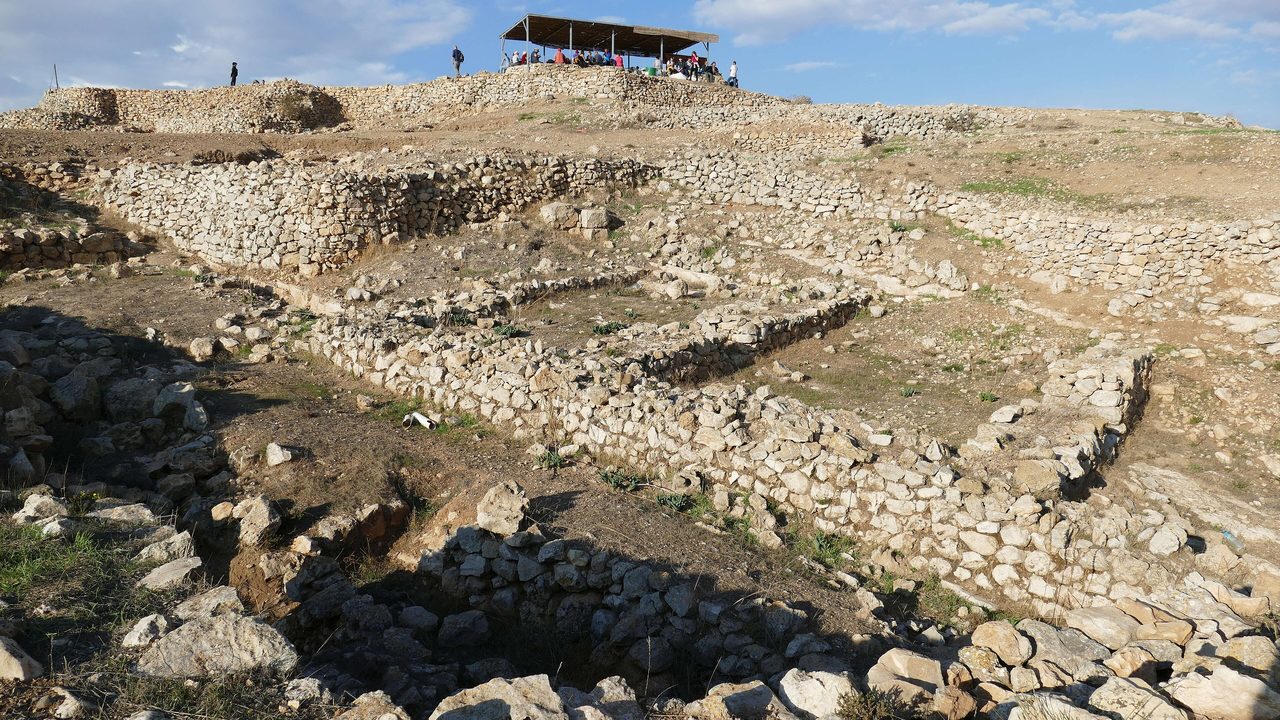
Ai is generally identified with Khirbet et-Tell, a tell — a mound raised by one settlement built on the ruins of the last. It has been excavated, and at its largest covered 9 hectares.
Occupation shows in 4 dated phases: Early Bronze Age IB, Early Bronze Age II, Early Bronze Age III, Iron Age I.
The excavation is from the survey dataset From Villages to Empires (Zanoni and others, 2025), used under CC BY 4.0. The identification is the one modern scholarship settles on, compiled by OpenBible.info from over seventy works, also under CC BY 4.0. Identifying a mound with a biblical name is a scholarly judgement, and for some places it is still debated.
Easton’s Bible Dictionary
One of the royal cities of the Canaanites (Joshua 10:1; Genesis 12:8; 13:3). It was the scene of Joshua’s defeat, and afterwards of his victory. It was the second Canaanite city taken by Israel (Joshua 7:2-5; 8:1-29). It lay rebuilt and inhibited by the Benjamites (Ezra 2:28; Nehemiah 7:32; 11:31). It lay to the east of Bethel, “beside Beth-aven.” The spot which is most probably the site of this ancient city is Haiyan, 2 miles east from Bethel. It lay up the Wady Suweinit, a steep, rugged valley, extending from the Jordan valley to Bethel.
From M. G. Easton, Illustrated Bible Dictionary (1893), in the public domain.
Named in 31 verses
The place, its people and its events come from Theographic, a knowledge graph of the Bible by Robert Rouse, used and shared under CC BY-SA 4.0.