Babylon
City
255 verses · 17 books
- Died here
- Jehoiachin, Zedekiah
Where the name appears
Events told in passages that name Babylon, and how many of their verses do. That is not the same as saying they happened here: a place can be named as a landmark, as somewhere being travelled to, or as the subject of a prophecy.
- 758 BCProphecies of Isaiah
- 753 BCProphecies of Micah
1 verse
Micah4:10 - 725 BCReign of Hezekiah
- 627 BCProphecies of Jeremiah
150 verses
Jeremiah20:420:520:621:221:421:721:1022:2524:125:125:925:1125:1225:2627:627:827:927:1127:1227:1327:1427:1627:1727:1827:2027:2228:228:328:428:628:1128:1429:129:329:429:1029:1529:2029:2129:2229:2832:232:332:432:532:2832:3634:134:234:334:734:2135:1136:2937:137:1737:1938:338:1738:1838:2238:2339:139:339:539:639:739:939:1139:1340:140:440:540:740:940:1141:241:1842:1143:343:1044:3046:246:1346:2649:2849:3050:150:250:850:950:1350:1450:1650:1750:1850:2350:2450:2850:2950:3450:3550:4250:4350:4550:4651:151:251:651:751:851:951:1151:1251:2451:2951:3051:3151:3351:3451:3551:3751:4151:4251:4451:4751:4851:4951:5351:5451:5551:5651:5851:5951:6051:6151:6452:352:452:952:1052:1152:1252:1552:1752:2652:2752:3152:3252:34 - 608 BCReign of Jehoiakim
- 605 BCProphecies of Daniel
- 597 BCReign of Jeconiah
- 596 BCReign of Zedekiah
- 592 BCProphecies of Ezekiel
- 519 BCProphecies of Zechariah
- 30 ADStephen addresses the council
1 verse
Acts7:43
Easton’s Bible Dictionary
The Greek form of BABEL; Semitic form Babilu, meaning “The Gate of God.” In the Assyrian tablets it means “The city of the dispersion of the tribes.” The monumental list of its kings reaches back to B.C. 2300, and includes Khammurabi, or Amraphel (q.v.), the contemporary of Abraham. It stood on the Euphrates, about 200 miles above its junction with the Tigris, which flowed through its midst and divided it into two almost equal parts. The Elamites invaded Chaldea (i.e., Lower Mesopotamia, or Shinar, and Upper Mesopotamia, or Accad, now combined into one) and held it in subjection. At length Khammu-rabi delivered it from the foreign yoke, and founded the new empire of Chaldea (q.v.), making Babylon the capital of the united kingdom. This city gradually grew in extent and grandeur, but in process of time it became subject to Assyria. On the fall of Nineveh (B.C. 606) it threw off the Assyrian yoke, and became the capital of the growing Babylonian empire. Under Nebuchadnezzar it became one of the most splendid cities of the ancient world.
After passing through various vicissitudes the city was occupied by Cyrus, “king of Elam,” B.C. 538, who issued a decree permitting the Jews to return to their own land (Ezra 1). It then ceased to be the capital of an empire. It was again and again visited by hostile armies, till its inhabitants were all driven from their homes, and the city became a complete desolation, its very site being forgotten from among men.
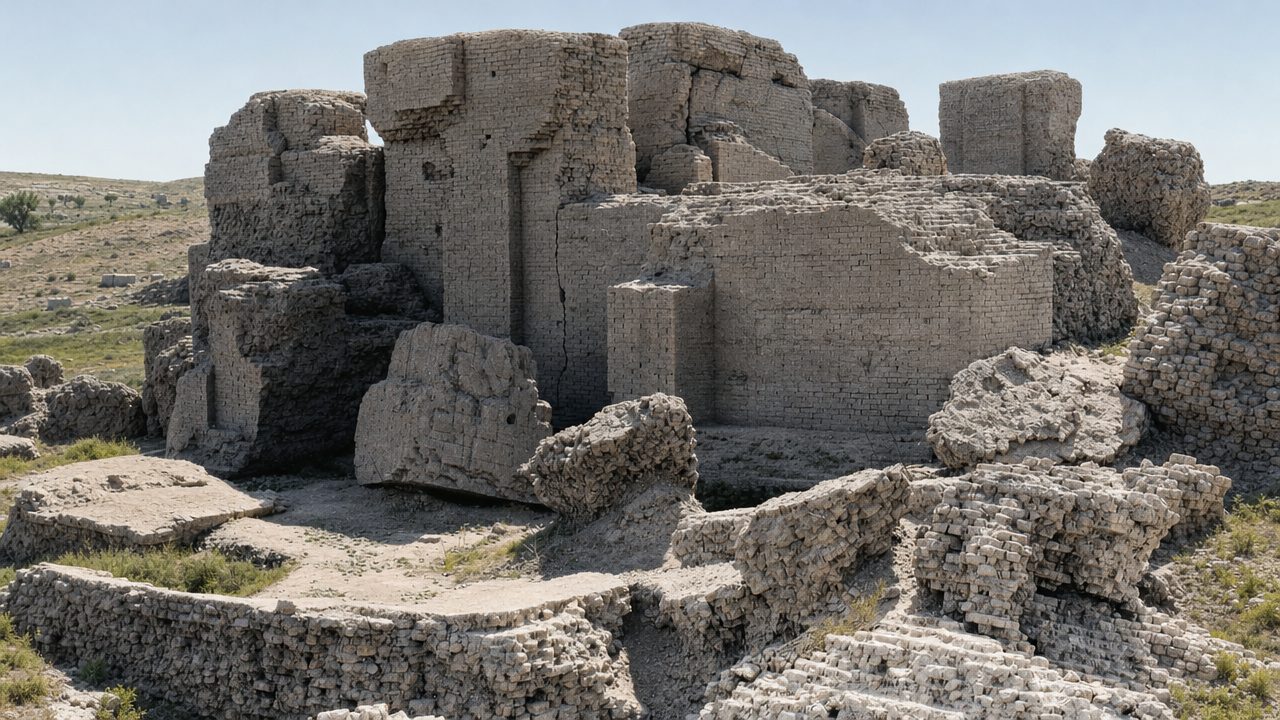
On the west bank of the Euphrates, about 50 miles south of Bagdad, there is found a series of artificial mounds of vast extent. These are the ruins of this once famous proud city. These ruins are principally (1) the great mound called Babil by the Arabs. This was probably the noted Temple of Belus, which was a pyramid about 480 feet high. (2) The Kasr (i.e., “the palace”). This was the great palace of Nebuchadnezzar. It is almost a square, each side of which is about 700 feet long. The little town of Hillah, near the site of Babylon, is built almost wholly of bricks taken from this single mound. (3) A lofty mound, on the summit of which stands a modern tomb called Amran ibn-Ali. This is probably the most ancient portion of the remains of the city, and represents the ruins of the famous hanging-gardens, or perhaps of some royal palace. The utter desolation of the city once called “The glory of kingdoms” (Isaiah 13:19) was foretold by the prophets (Isaiah 13:4-22; Jeremiah 25:12; 50:2, 3; Daniel 2:31-38).
The Babylon mentioned in 1 Peter 5:13 was not Rome, as some have thought, but the literal city of Babylon, which was inhabited by many Jews at the time Peter wrote.
In Revelation 14:8; 16:19; 17:5; and 18:2, “Babylon” is supposed to mean Rome, not considered as pagan, but as the prolongation of the ancient power in the papal form. Rome, pagan and papal, is regarded as one power. “The literal Babylon was the beginner and supporter of tyranny and idolatry...This city and its whole empire were taken by the Persians under Cyrus; the Persians were subdued by the Macedonians, and the Macedonians by the Romans; so that Rome succeeded to the power of old Babylon. And it was her method to adopt the worship of the false deities she had conquered; so that by her own act she became the heiress and successor of all the Babylonian idolatry, and of all that was introduced into it by the immediate successors of Babylon, and consequently of all the idolatry of the earth.” Rome, or “mystical Babylon,” is “that great city which reigneth over the kings of the earth” (17:18).
From M. G. Easton, Illustrated Bible Dictionary (1893), in the public domain.
Named in 255 verses
2 Kings28 verses
1 Chronicles1 verse
Esther1 verse
Isaiah13 verses
Ezekiel15 verses
Micah1 verse
Acts1 verse
1 Peter1 verse
The place, its people and its events come from Theographic, a knowledge graph of the Bible by Robert Rouse, used and shared under CC BY-SA 4.0.