Places of the Bible
Joppa
City
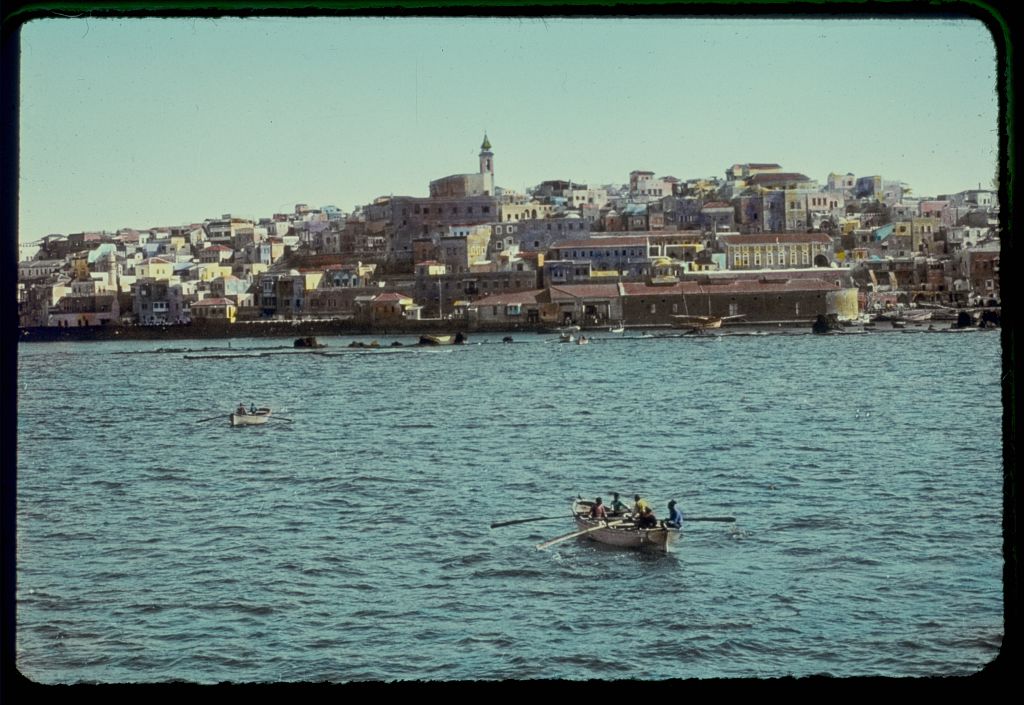
What happened here
- Peter heals Aeneas and Dorcas · 38 AD
- Peter meets Cornelius · 38 AD
Where the name appears
Events told in passages that name Joppa, and how many of their verses do. That is not the same as saying they happened here: a place can be named as a landmark, as somewhere being travelled to, or as the subject of a prophecy.
A dot is a moment; a bar is something that lasted, drawn to its length. The fainter the mark, the fewer verses name the place.
- Prophecies of Jonah · 824 BC · 1 verse
- Peter defends Gentile salvation · 38 AD · 2 verses
What the spade found
Joppa is generally identified with Tel Yafo, a tell — a mound raised by one settlement built on the ruins of the last. It has been excavated.
Occupation shows in 11 dated phases: Early Bronze Age, Middle Bronze Age II-III, Late Bronze Age I, Late Bronze Age II, Late Bronze Age III, Iron Age I, Iron Age II, Iron Age III (Persian), Hellenistic, Roman, Byzantine.
The excavation is from the survey dataset From Villages to Empires (Zanoni and others, 2025), used under CC BY 4.0. The identification is the one modern scholarship settles on, compiled by OpenBible.info from over seventy works, also under CC BY 4.0. Identifying a mound with a biblical name is a scholarly judgement, and for some places it is still debated.
Easton’s Bible Dictionary
Beauty, a town in the portion of Dan (Josh. 19:46; A.V., “Japho”), on a sandy promontory between Caesarea and Gaza, and at a distance of 30 miles north-west from Jerusalem. It is one of the oldest towns in Asia. It was and still is the chief sea-port of Judea. It was never wrested from the Phoenicians. It became a Jewish town only in the second century B.C. It was from this port that Jonah “took ship to flee from the presence of the Lord” (Jonah 1:3). To this place also the wood cut in Lebanon by Hiram’s men for Solomon was brought in floats (2 Chr. 2:16); and here the material for the building of the second temple was also landed (Ezra 3:7). At Joppa, in the house of Simon the tanner, “by the sea-side,” Peter resided “many days,” and here, “on the house-top,” he had his “vision of tolerance” (Acts 9:36-43). It bears the modern name of Jaffa, and exibituds all the decrepitude and squalor of cities ruled over by the Turks. “Scarcely any other town has been so often overthrown, sacked, pillaged, burned, and rebuilt.” Its present population is said to be about 16,000. It was taken by the French under Napoleon in 1799, who gave orders for the massacre here of 4,000 prisoners. It is connected with Jerusalem by the only carriage road that exists in the country, and also by a railway completed in 1892. It is noticed on monuments B.C. 1600-1300, and was attacked by Sannacharib B.C. 702.
From M. G. Easton, Illustrated Bible Dictionary (1893), in the public domain.
Named in 14 verses
- Joshua
- 19:46
- 2 Chronicles
- 2:16
- Ezra
- 3:7
- Jonah
- 1:3
- Acts
- 9:36, 9:38, 9:42, 9:43, 10:5, 10:8, 10:23, 10:32, 11:5, 11:13
The place, its people and its events come from Theographic, a knowledge graph of the Bible by Robert Rouse, used and shared under CC BY-SA 4.0.